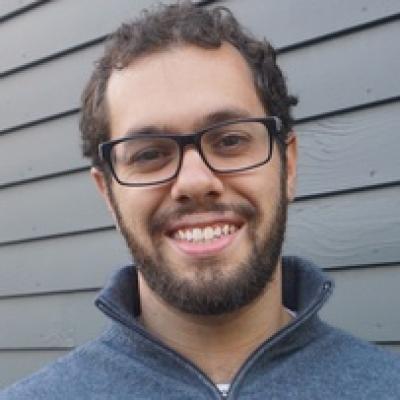
Adam Lechowicz ’22
Adam Lechowicz ’22 has spent his time at Manning CICS and UMass finding ways to leave both better than he found them.
Stuck at home during the first summer of the COVID-19 pandemic, a bored Adam Lechowicz ’22 decided to put the coding skills he learned at the Manning College of Information and Computer Sciences (CICS) to the test.
Armed with both a curiosity about the unique brutalist architecture on the University of Massachusetts Amherst campus and a book on the subject, the rising computer science junior built a smartphone app that gave users a guided tour of the school’s buildings.
So, when Manning CICS announced a few years later that it was breaking ground on a new Computer Science Laboratories (CSL) building, Lechowicz thought he could contribute. One email to the dean later, and he found himself on the building committee—a role that culminated at the official ribbon-cutting of the CSL in September.
“This place gave me a lot,” said Lechowicz, now a doctoral candidate at Manning CICS. “The least I can do is put some effort back to make it better for the next person.”
Lechowicz’s work on the CSL might be one of his most visible contributions to the University of Massachusetts Amherst and Manning CICS, but it’s far from his only. That same instinct—to leave something better than he found it—shows up throughout his academic career, connecting a bored undergrad to a PhD researcher trying to create more sustainable computing systems.
“Coming to UMass as an undergraduate was a very impactful experience for me—[it] meant a lot to me personally,” Lechowicz said. “Professionally, it’s so intertwined with me that it’s impossible to separate me from UMass.”
Finding His Why
Lechowicz remembers growing up in the “app 1.0” era, when smartphones were changing how people communicated and society functioned.
“I think the lesson I learned from that cultural moment in time ... is that the technology that we build has great innate power to help people and to advance society, to make things better for all people,” Lechowicz said.
Lechowicz saw technology not as an abstract concept but as a tool for doing good—a tool that needed a “why,” which he aimed to discover through his second major in political science.
“It was also very instrumental in understanding how what we do as computer scientists, and what we do as scientists more generally, connects with and intertwines with a lot of complicated sociopolitical concepts that society grapples with,” Lechowicz said about his political science studies.
The journey to find his “why” didn’t just end with taking on another major—Lechowicz took an active role in campus leadership throughout his undergraduate career.
He became a senator and secretary of technology for the Student Government Association (SGA), revived the university’s yearbook, and joined the Manning CICS Committee Against Racism and for Equity, among other endeavors. After his undergraduate career, he also served as a student trustee on the University of Massachusetts Board of Trustees.
In each role, he did what he’d keep doing for years to come: finding ways to make things better for the people around him.
Research That Serves
Lechowicz hadn’t considered enrolling in the PhD program at Manning CICS until his honors thesis advisor, Associate Professor Cameron Musco, encouraged him to do it. He applied to a few schools but found himself coming back to Manning CICS.
“I really liked the research fit here at UMass,” he said. “It was very hard to pass that up.”
As a graduate student, Lechowicz focuses his research on the intersection of theoretical computer science and systems, specifically on decision-making under uncertainty, which explores how computer systems make choices when information is limited.
“Through my PhD research and through my affiliated lab research, we've applied this idea to sustainability challenges in computing systems,” he said.
One example is the growing environmental footprint of AI data centers, which consume significant amounts of energy and water. Lechowicz’s research explores how computer systems can shift workloads to better match available energy from sources like solar and wind. His work also looks at how AI can assist with these kinds of decisions.
“One of the things that really excites me about this research area is that it has that impact that I was looking for—that societal connection,” he said.
Lechowicz shares some of the public’s concerns about generative AI’s societal impact.
“I think some of what motivates me to continue doing my work is trying to use whatever position I have in academia to advocate for the sort of thoughtful deployment and usage of these technologies,” he said.
Agent of Change
Lechowicz remembers what the north side of campus was like before the Computer Science Laboratories building was built.
“This corner of campus was pretty quiet and there wasn’t a lot of activity, mostly because undergrads didn’t even really have courses here at the time,” he said.
The CSL has changed that, giving students a new place to learn and gather—and Lechowicz had a hand in shaping it. As a member of the building committee, he advocated for greater accessibility throughout the building, contributing to features such as barrier-free bathrooms. Sustainability was also a major priority across the project, and the CSL earned Leadership in Energy and Environmental Design (LEED) Platinum certification, the first building on campus to achieve that distinction.
“Every day I walk through and I get to look at the building come alive and what different undergrads are up to,” he said. “It brings the space alive in a way that I couldn't have even probably projected at the time.”
Since Lechowicz arrived at UMass as an undergraduate, the college has grown considerably, both physically and academically. Now in the final year of his PhD, he can see that transformation in the classrooms, research spaces, and gathering places he helped shape.
While his time at UMass is ending, he’s optimistic about what comes next for the community he’s spent years helping to strengthen.
“It’s a little bit sad, actually, to be leaving this place just when it feels like it’s really hitting its stride and launching into the stratosphere,” he said.